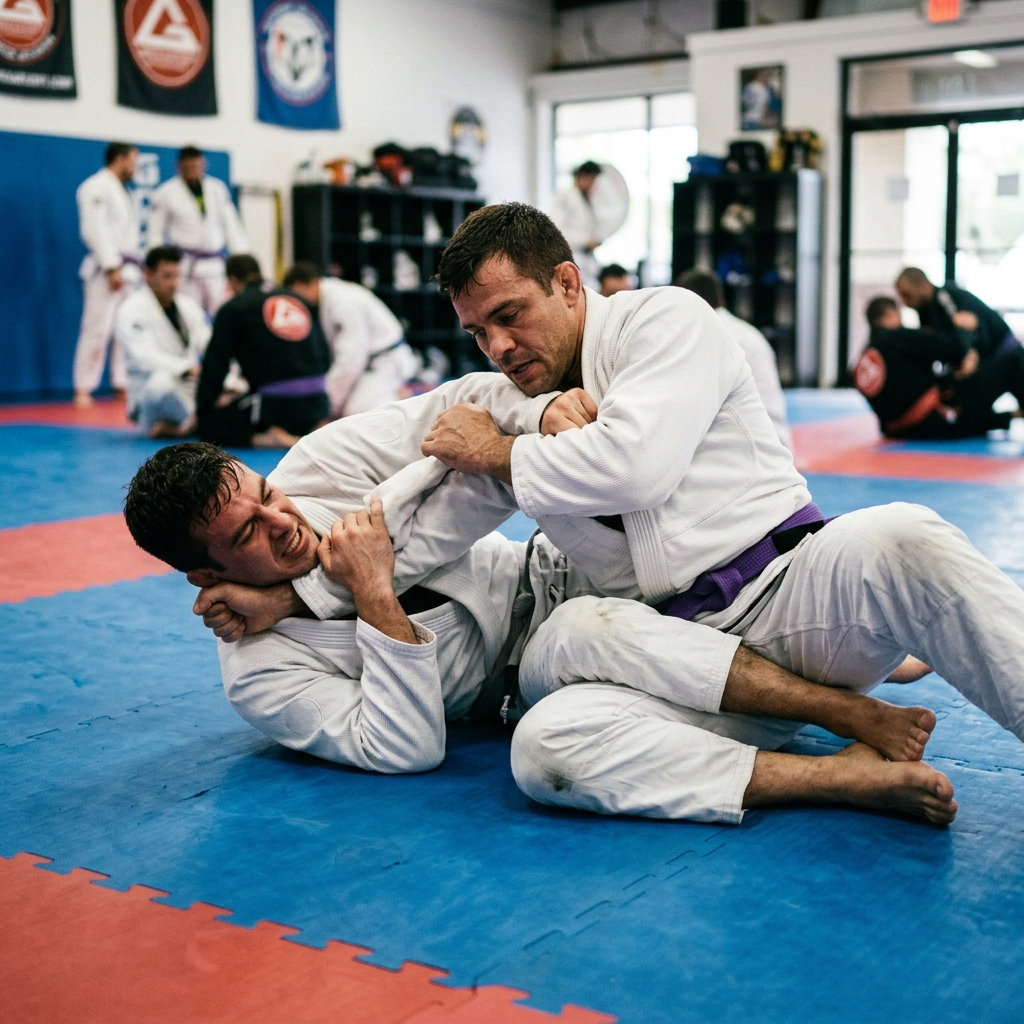
Guillotine Choke for Beginners: Stop Takedowns and Get Faster Taps
What is a guillotine choke? A guillotine choke is a front headlock submission where you encircle an opponent's neck with your arm, trapping their head under your armpit. By locking your hands together and pulling upward while crunching your torso, the blade of your forearm compresses their carotid arteries and trachea, resulting in a rapid blood or air choke.
It is one of the fastest and most effective submissions in BJJ. When I first started training, I relied heavily on my wrestling background. I shot for takedowns constantly. But there was one submission that completely neutralized my wrestling: the guillotine choke. Every time I left my head down, I got snapped down and choked. It forced me to adapt, and eventually, it became my favorite weapon.
If you are a white belt tired of getting smashed by bigger grapplers, this guide is for you. You will learn the exact hand positioning, the "chopstick" leg lock, and why pulling backwards is the easiest way to lose the submission.
Before you dive in, make sure to check out our complete BJJ techniques guide to see how the guillotine fits into your overall submission game.
What is a guillotine choke in BJJ?
The guillotine choke (often simply called "the guillotine") is a foundational grappling technique. It targets the neck from a front headlock position. Depending on your grip and angle, it acts as either a blood choke (restricting the carotid arteries) or an air choke (compressing the trachea).
According to ADCC submission data, the guillotine remains one of the highest-percentage finishes at the elite level. It works in gi, no-gi, and MMA.
There are two main variations: the arm-in guillotine and the arm-out guillotine. For beginners, the arm-out guillotine (where you only wrap the opponent's head) is usually the most effective and easiest to finish. Once you master the mechanics of the arm-out version, adding the arm-in variation becomes much simpler.
How do you set up the guillotine choke?
The absolute best time to hit a guillotine choke is when an opponent makes a mistake with their head position. You do not need to force it. You just need to be ready when they hand it to you.
Look for these two high-percentage triggers:
- The sloppy takedown: When someone shoots for a double leg or single leg takedown but leaves their head down and off to the side, their neck is wide open.
- The lazy turtle: When an opponent rolls to the turtle position but fails to tuck their chin and cover their neck.
Step-by-step: How to execute the arm-out guillotine
Getting your arm around the neck is only 10 percent of the technique. The finish is entirely about hand positioning and leg control.
Here is the step-by-step breakdown of the "knife and chopstick" method.
1. Wrap the neck and form the knife. Shoot your choking arm deep over the back of their neck and under their chin. Create a "knife" with your hand, keeping it flat and facing upward. 2. Connect your hands. Use your free hand to grab your choking hand. Pull the choking hand up even higher to secure the grip. 3. Swipe the chest. Think of your arms as a circle. To guarantee the choke, you must make that circle as small as possible. Imagine the palm of your choking hand touching your chest. Swipe that hand across your chest toward your same side shoulder. The hole gets smaller, and the pressure increases. 4. Drop the elbow. As your choking hand moves up and across, drop your choking elbow straight down toward your ribs. 5. Throw the chopstick leg. Opponents will instantly try to roll to escape the pressure. To stop the roll, throw your leg (the one opposite to your choking arm) over their back. 6. Lock the trap. Take your other leg (on the same side as your choking arm) and fold it across and under their body, like a pair of chopsticks. This completely immobilizes their hips. 7. Crunch, do not pull. Do not extend your back. Crunch your torso forward. Put downward pressure on the back of their head with your chest while your arms pull up.
Why do white belts always lose the guillotine? (Common mistakes)
I see white belts catch a great front headlock, lock their hands, and then completely burn out their arms trying to get the tap. They usually make one of these two errors.
Extending the back for a "big pull" The instinct is to arch your back and pull with all your might. This actually creates space. When you extend your back, you stretch the circle around their neck. Instead, keep your arm tight and perform a crunching maneuver. Drive your chest down into the back of their head while your forearm pulls up.
Leaving too much space A choke is simply constriction around the neck to stop blood flow. If your arm is loose, the blood keeps flowing. You must eliminate all space. Swipe that hand across your chest and drop the elbow. If they can turn their chin, the circle is too big.
How to drill the guillotine safely
You need to build muscle memory without crushing your training partners' windpipes.
- Solo drilling: Practice the "chest swipe" motion in the mirror. Hand flat, facing up. Swipe across the chest, drop the elbow, crunch forward.
- Partner drilling (static): Have a partner start in your closed guard with their head down. Slowly lock the grip, apply the chopstick leg control, and slowly apply the crunch until they tap. Release immediately.
- Live application: Start from a standing position. Have your partner shoot a slow double leg with their head completely exposed. Sprawl, wrap the neck, pull them into your guard, and lock the technique.
When should you use the guillotine in a live roll?
The guillotine choke pairs perfectly with a defensive, counter-attacking style. It is the ultimate punisher for bad posture.
If you are playing closed guard and your opponent tries to bury their head in your chest to stall, sit up and wrap the neck.
If you are defending a guard pass and the opponent leaves their neck exposed, threaten the choke. Even if you do not finish the submission, the threat of the guillotine will force them to abandon the pass and defend their neck.
It also chains directly into other attacks. If they successfully defend the guillotine by pulling their head out, their arms are often extended, leaving them wide open for a kimura submission or a triangle choke.
Ready to drill this live?
Reading about the "chest swipe" is one thing. Actually feeling the leverage on the mats is another. If you do not have a home gym yet, find a spot to train. Check out our directory to find a BJJ gym in Los Angeles (or your local city) and start drilling.
Frequently asked questions about the guillotine choke
What is the easiest BJJ submission to learn? The arm-out guillotine choke is often considered one of the easiest submissions for beginners to learn. It requires very little flexibility and can be hit from multiple positions, including standing, guard, and turtle.
Is the guillotine a blood choke or an air choke? Depending on the forearm placement, it can be both. A perfectly executed guillotine targets the carotid arteries (blood choke), putting the opponent to sleep in seconds. A poorly placed guillotine crushes the trachea (air choke), which is painful and forces a tap but is less efficient.
How do I stop someone from rolling out of my guillotine? You must control their hips. Throw your leg over their back on the side opposite your choking arm, and use your other leg to lock it in place (the "chopstick" control). If you control their hips, they cannot roll.
Why do my arms get tired when trying to finish? You are likely using bicep strength to pull their head off. Engage your lats, drop your elbow, and use your core to perform a crunching motion. Leverage finishes the choke, not arm strength.
The final tap
The guillotine choke is a mandatory tool for any white belt. It stops takedowns, punishes lazy posture, and ends matches quickly.
Focus on making the circle around their neck as small as possible. Swipe the hand across the chest, drop the elbow, and crunch. Master this, and you will never fear a sloppy wrestler again.
For more escapes and defensive tactics, read our guide on how to escape mount and keep building your foundation.
Ready to test it out? Find a BJJ gym near you and get on the mats.