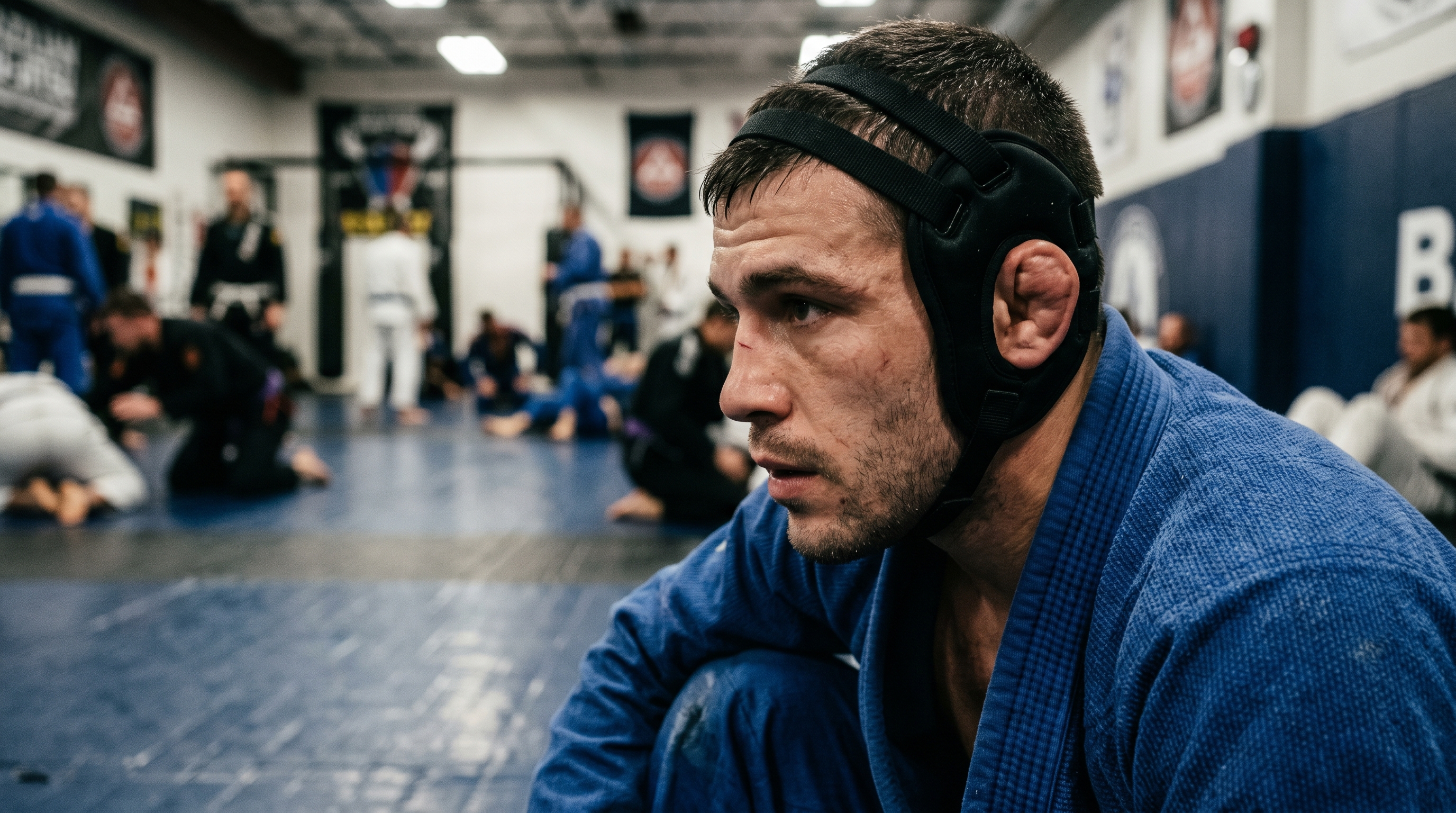
Cauliflower Ear in BJJ: How to Prevent It, and What to Do If You Already Have One
Cauliflower ear is what you get when you ignore a swollen ear after training. Blood pools between the cartilage and the skin, and if nobody drains it fast, it hardens into the lumpy, permanent shape you have seen on wrestlers and old BJJ black belts. I have it. I got mine wrestling in high school, and I waited so long that a doctor had to cut it open with a scalpel and scrape it out.
So I am not writing this from a textbook. Here is how you actually get cauliflower ear in jiu jitsu, how to keep it off your face with one cheap piece of gear, and what to do the night your ear blows up so you do not end up in the ER like I did.
One thing first: I am a grappler, not a doctor. Everything here is my own experience, checked against medical references like StatPearls and the MSD Manual. If your ear swells up, get a real professional to look at it.
What cauliflower ear actually is
The medical name is an auricular hematoma. Your outer ear is a thin layer of skin stretched over cartilage, with no real cushion in between. When that ear takes enough friction or a hard knock, the skin shears away from the cartilage and the gap fills with blood.
That fluid is the swelling you feel. If it drains or gets reabsorbed quickly, the ear heals normal. If it sits there, the body turns the trapped blood into scar tissue and new cartilage, and the ear sets in that thick, folded shape for good. That is the cauliflower.
It is not a bruise and it is not an infection. It is a blood blister under the skin of your ear, and the clock starts the moment it fills.
One quick distinction: the stuff that actually is an infection, like staph or ringworm, is a separate problem with separate fixes. Our mat hygiene guide covers that side of staying healthy on the mats.
What it felt like when mine first came in
The first sign was tenderness. My ear felt sore and a little hot, like it had been flicked a hundred times, which after a hard wrestling practice is basically true.
Then it got soft. I could press on the top of my ear and feel fluid move under the skin, like a little water balloon. No sharp pain at that point, just pressure and heat.
I thought it looked cool. So I did the dumbest thing you can do: nothing. I left it alone and kept training on it.
Why I ended up getting it scraped out in the ER
It kept getting bigger. Every practice I was grinding the same ear into the mat, and every night it refilled. After a couple of weeks it was swollen enough that I started worrying it was going to stay deformed.
By the time I got to the emergency room, the soft fluid was gone. It had hardened. A needle would not touch it anymore. So they numbed it, took a scalpel, opened it up, and scraped the calcified tissue and old blood out of my ear. Then they stitched it shut and put a little molded cast on it to hold the shape.
Here is the lesson I paid for: if I had gone in during those first couple of days, while it was still soft, they could have drained it with a needle in five minutes. I waited, and it cost me a minor surgery and a permanent lump.
The mistake that turns a tweaked ear into a permanent one
The single biggest mistake I see white belts make is the exact one I made. They feel the ear get hot and puffy, they decide it is no big deal, and they keep training on it without protecting it.
A few specific things make it worse fast:
- No headgear. If an ear is already sensitive and you keep grinding it into the mat passing guard or stuck under side control, you pump it back up every round.
- Sleeping on it. Lying on a fresh, swollen ear all night keeps the pressure on it and keeps it irritated.
- Rubbing or pressing it. Poking at it, dragging it across a gi sleeve, messing with it out of curiosity. Anything that keeps shearing that skin keeps it filling.
How to prevent cauliflower ear in BJJ: headgear is most of it
Real prevention is not complicated. It is mostly one thing.
Wear headgear. This is the number one way to keep your ears normal, full stop. Any wrestling headgear works. The standard brands are Cliff Keen and Asics, and a set runs around thirty dollars. You do not need anything fancy. You need to actually wear it, especially on hard training days and any time an ear is already tender. Most people own headgear and leave it in the bag. The headgear in your bag does nothing.
A couple of smaller habits stack on top of that:
- Switch sides. If you always frame with the same side of your head or always pass to the same side, you grind one ear constantly. Mix it up so no single ear takes all the abuse.
- Protect a hot ear. The moment one ear feels tender, that is when headgear stops being optional. Train lighter on it and keep it off the mat until it calms down.
- Do not sleep on a sore ear. Give it the night off.
Caught it early? Here is the window to get it drained
If your ear blows up after training, you have a short window, so do not sit on it the way I did.
The blood in there starts to clot within about six hours, and draining it cleanly with a needle works best in the first day or two while it is still liquid, per references like the MSD Manual. After roughly 48 hours it starts to organize into the firm tissue that becomes permanent.
What to actually do:
- Get it looked at fast. Urgent care, your doctor, or an ER can drain a fresh hematoma, either with a needle or a small incision, then put a compression dressing on it.
- Compression is the part people skip. A drained ear refills if it is not pressed flat while it heals. That dressing or splint is what makes the drain hold.
- Be careful with DIY draining. A lot of grapplers drain their own ears. I get the appeal, but you are putting a needle into your own cartilage, and the two real risks are infection and it filling right back up. Getting it done by a clinician is the safer call.
Again, not medical advice. This is the part where you talk to an actual doctor about your actual ear.
Should you just embrace it?
Honest take: cauliflower ear is fine. I have it, a lot of my training partners have it, and there is nothing wrong with it. If you get one and you like the way it looks, keep it. It is a normal part of grappling and it does not slow you down.
What I would not do is chase it on purpose. Do not be the guy trying to manufacture a cauliflower ear to look tough. Just train hard and let your ears do whatever they do.
The one time to step in is when it gets out of hand. If a cauliflower ear swells so big that it starts covering the opening of your ear or gets badly misshapen, that is when you want a doctor involved. Short of that, it is a cosmetic thing, and it is your call.
So pick your side. Want to keep your ears clean? Wear headgear every session, and drain anything that swells up fast. Do not mind the badge? Train on and wear it proud. Both are valid. The only bad option is the one I picked at sixteen: ignore it until a scalpel gets involved.
How this guide was put together
This one is firsthand: I have cauliflower ear and went through the drained-it-too-late, got-it-cut-open version myself. I checked the medical details, the draining window, the auricular hematoma mechanism, and the otoplasty option, against references like StatPearls and the MSD Manual. If you have grappled longer than me and see it differently, tell me and I will update this.