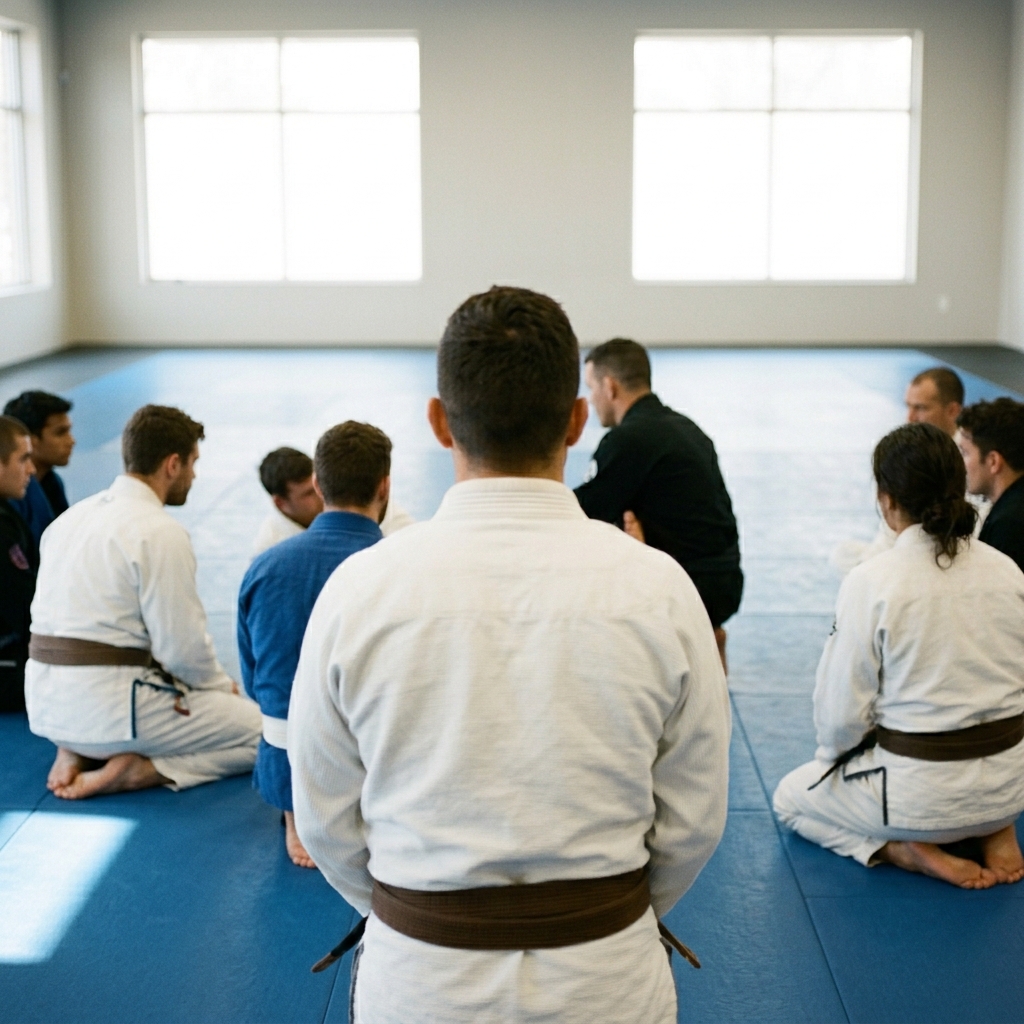
John Danaher’s Masterclass: Core Principles, Training Philosophy, and the Evolution of Jiu-Jitsu
When we talk about the evolution of modern Brazilian Jiu-Jitsu and submission grappling, one name invariably dominates the conversation: John Danaher. Revered as the architect behind some of the greatest athletes in combat sports history—including Gordon Ryan, Georges St-Pierre (GSP), and Garry Tonon—Danaher’s analytical approach to grappling has completely revolutionized the sport.
This comprehensive guide distills Danaher's core principles, personal anecdotes, and unyielding training philosophies extracted from his most profound interviews and instructional masterclasses. Whether you're a white belt seeking direction or a seasoned competitor looking to optimize your game, these insights provide a roadmap to maximizing your progress in minimum time.
---
The "Curious Idiot": Danaher's Unlikely Journey
John Danaher’s path to becoming the most sought-after coach in martial arts is anything but traditional.
Born in the United States to a New Zealand Royal Air Force pilot, Danaher was raised in the idyllic nature of New Zealand. He eventually made his way to New York City to pursue a Ph.D. in Philosophy at Columbia University. While working as a nightclub bouncer to pay the bills, he found himself repeatedly in physical altercations.
At age 28, with a "crippled left leg" and no prior grappling experience, a small academic colleague at Columbia challenged Danaher to hold him down. Despite Danaher's size and street fighting experience, the colleague—who had only trained in Jiu-Jitsu for two weeks—effortlessly escaped and took Danaher's back.
This humiliating yet eye-opening experience sparked an obsession. "I couldn't stomach the idea that there's people out there smaller than me who can just toy with me like a child," Danaher recalls. His initial goal wasn't to become a world champion coach; it was simply: "I didn't want to be incompetent."
From Academia to the Mats
As Danaher immersed himself in the martial art, he applied the analytical rigor of his philosophy background to Jiu-Jitsu. When his mentors at the Renzo Gracie Academy left, Danaher was thrust into a teaching role. He faced a monumental life decision: the safe, predictable path of a tenured philosophy professor, or the high-risk, obscure path of a Jiu-Jitsu coach in an era where MMA was still illegal in New York.Danaher chose the mat. He viewed Jiu-Jitsu much like the Wright Brothers viewed early flight—holding something of immense intrinsic value that the rest of the world simply hadn't realized yet.
> "Mentally, I see myself as a curious idiot. I usually start at a fairly low point, but because I'm persistent over time and I'm curious, I keep asking questions and trying to find answers." — John Danaher
---
Core Training Philosophies: Maximizing Progress in Minimum Time
A central theme in Danaher's coaching is the pursuit of maximum progress in minimum time. He firmly states that "there is no free lunch in jiu-jitsu; you will have to work hard for all of your progress." However, there are intelligent shortcuts.
Danaher advocates for four key factors to radically increase your submission rate and overall skill level:
1. Choice: High-Percentage Over Low-Percentage
Not all submission holds are created equal. Danaher emphasizes that 90% of what he teaches revolves around roughly six major submission families.- The Principle: Choose the most high-percentage submissions that work across all weight classes, body types, and skill levels.
- The Application: It is infinitely better to be an absolute expert in a small number of highly effective moves than to be mediocre at a vast array of low-percentage, flashy techniques.
2. Immersion
Drawing a parallel to learning a foreign language, Danaher argues that reading a textbook for 10 minutes a day is useless compared to being dropped into a foreign country where you must use the language to survive.- The Principle: Once you choose a technique, immerse yourself in it completely. Study its history, watch the athletes who use it best, and obsess over how it fits your specific body type.
3. Focus: The Art of Exclusion
Jiu-Jitsu is full of distractions. Every day there is a new "move of the day" on Instagram.- The Principle: Focus on your chosen, high-percentage skills even if it means completely excluding other, less important skills. Eliminating distractions is a massive part of sustaining useful progress.
4. Identifying Opportunity & Pulling the Trigger
An athlete who knows a technique but hesitates to use it is practically no better than an athlete who doesn't know the technique at all. The Principle: You must train your mind to instantly recognize the window of opportunity in a live spar, and cultivate the confidence to pull the trigger* without hesitation.---
The Science of Sparring and Self-Assessment
The Danger of the "Risk-Averse" Mindset
Human beings are naturally risk-averse, fearing loss more than they desire gain. In Jiu-Jitsu, this manifests when two evenly matched partners roll. Because neither wants to lose, they stick strictly to their established "A-Game." While this sharpens execution slightly, it severely stunts organic growth.- The Solution: To grow, you must play with lower belts. When rolling with someone less skilled, the fear of losing vanishes, allowing you to take risks, experiment with new (untested) techniques, and build them from "small beginnings."
Accurate Self-Assessment via Video
Progress requires an aggressively honest understanding of where you currently stand. Humans are terrible at self-assessment—we either over-inflate our abilities or suffer from imposter syndrome.- The Danaher Method: Use video. Video doesn't lie. Record your sparring sessions to objectively analyze your weaknesses, identify recurring mistakes, and build a historical reference point to measure your progress year over year.
Positional Sparring
Danaher is a massive proponent of positional sparring over unstructured, neutral sparring.- If you have a weakness in escaping back control, start every round in back control.
- Drill the mechanics with zero resistance, gradually increase the resistance, and then spar positionally against increasingly tougher opponents until your weakness becomes a strength.
Coaching Methodology: Building a Culture of Excellence
Danaher measures his success by a single metric: "Am I making measurable differences in the performance of my students towards their goals?"
The Importance of Culture
Danaher notes that global success in sports is never evenly distributed. Whether it's sprinting in Jamaica, rugby in New Zealand, or wrestling in the Caucasus regions—excellence is highly concentrated. This isn't due to genetics; it's due to culture.- The Coach's Job: To create a culture of excellence where skill acquisition is the absolute highest priority.
- The Standard: Everyone in the room must hold themselves to the standard of a world champion. Even the lowest-ranked white belt should feel they are part of a "cauldron that's so hot it creates world champions."
Finding Undervalued Assets
Danaher views Jiu-Jitsu techniques like the stock market. He actively looks for movements or tactics that have incredible intrinsic value but are perceived as "cheap" or useless by the masses. (A prime example is his early adoption and systemization of Leg Locks, which were widely dismissed by the traditional BJJ community until his squad used them to dominate the grappling world).Philosophy in Coaching: Asking the Right Questions
Drawing from his academic background, Danaher believes that in a world of ambiguous answers, the most vital skill is asking the right questions. > "For everything you do, ask one question: 'Is this really the best way of doing things?' In the vast majority of cases, the reason you're doing things the way you are is because that's the way you were taught. It's not because you've proven it's the best way... it's just the way it's always been done."---
The Evolution of the Martial Arts Paradigm
Danaher had a front-row seat to the evolution of modern martial arts. Growing up in the 1980s, striking was considered the ultimate form of combat. Grappling was an afterthought. The early UFCs shattered this illusion, proving that a smaller grappler could consistently neutralize a larger striker.
When Danaher began coaching Georges St-Pierre, he saw the next paradigm shift. GSP wasn't a wild, bloodthirsty brawler; he was a "gentleman and a scholar in a world full of savages." More importantly, GSP represented the integration of all martial arts. He wasn't necessarily the single best striker or the single best grappler, but his ability to seamlessly integrate the transitions between striking, wrestling, and Jiu-Jitsu changed MMA forever.
---
Conclusion: The Unfalsifiable Truth of the Mat
Unlike normal daily life, where people can manipulate their body language, put on fake personas, and pretend to be something they are not, Jiu-Jitsu demands absolute honesty.
As Danaher points out, "You can't fake your heart rate. You can't fake your breathing. You can't fake your stress levels. In Jiu-Jitsu, you either can or you can't."
For John Danaher, Jiu-Jitsu isn't just a sport; it's a mechanism for radical self-improvement, a physical expression of logic and physics, and a communal project where a group of dedicated individuals endure shared suffering to achieve a common goal of excellence.
Final Takeaway for the Practitioner: 1. Choose high-percentage moves. 2. Immerse yourself deeply. 3. Ignore distractions. 4. Film your rolls. 5. Ask yourself every day: "Is this really the best way?"