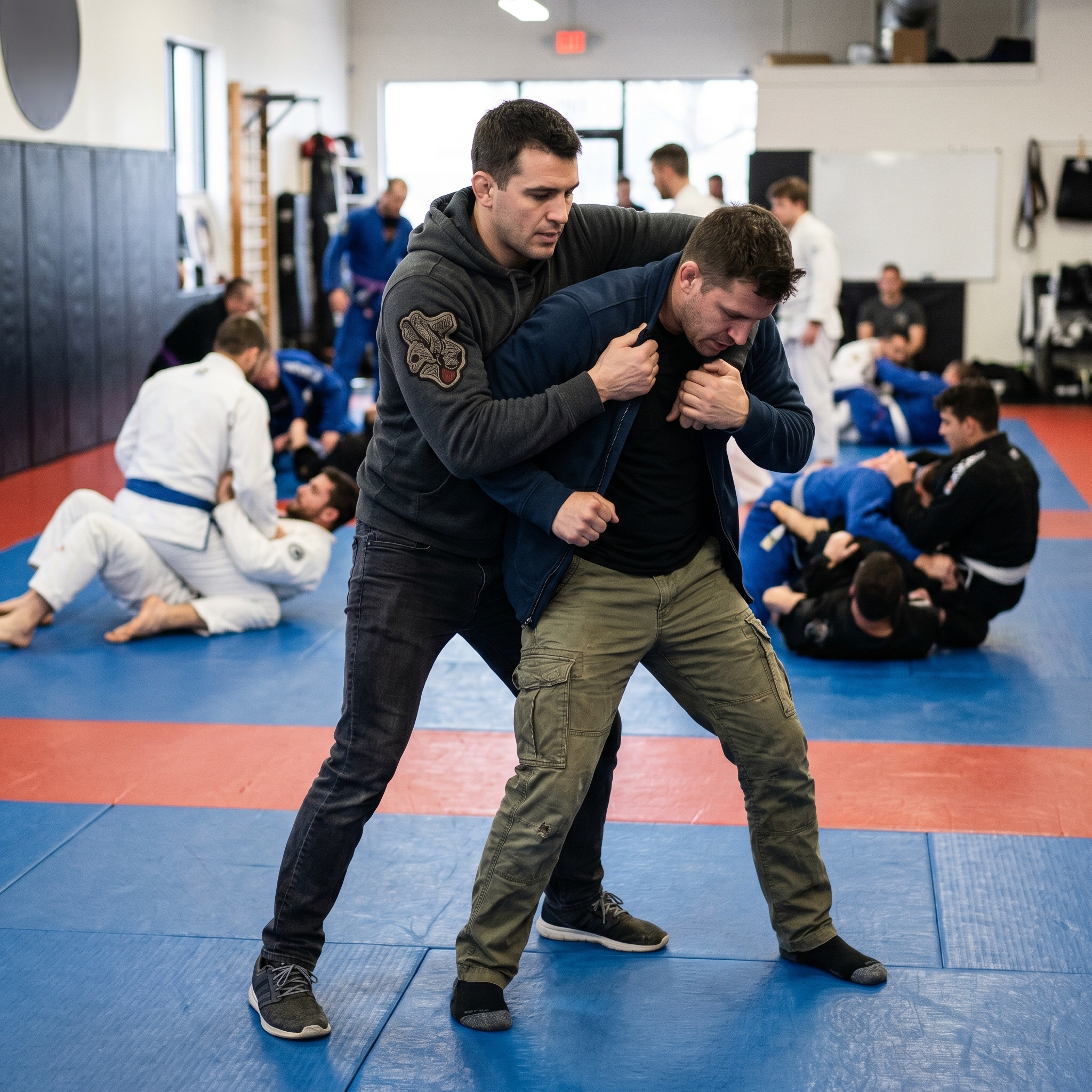
Is BJJ Good for Self Defense? Everything You Need to Know
Last Updated: January 2026
Quick Answer: Yes, Brazilian Jiu-Jitsu is one of the most effective martial arts for real-world self-defense. Its focus on ground fighting, submissions, and controlling opponents makes it particularly valuable because most street fights end up on the ground—and most people don't know what to do there.
---
Key Takeaways
- BJJ is highly effective for self-defense because it teaches you to control and neutralize threats without relying on striking
- Most street fights go to the ground within seconds, where BJJ practitioners have a massive advantage
- BJJ works regardless of size difference—technique and leverage beat raw strength
- Training BJJ also provides the cardio, mental toughness, and stress inoculation needed in real confrontations
- No martial art is complete for self-defense alone—understanding BJJ's limitations is part of using it effectively
Why BJJ Works for Self-Defense
Most Fights Go to the Ground
Research consistently shows that a majority of real-world physical confrontations end up on the ground. A 1988 LAPD study found that 95% of street fights involved some form of clinching or ground fighting. More recent analyses of street fight videos confirm this pattern.
Why this matters for you: If you don't know how to fight on the ground, you're relying entirely on the fight staying standing—and that's not your choice to make. BJJ gives you competence where most people have none.
BJJ Controls Without Injury (When You Want)
Unlike striking-based martial arts, BJJ allows you to control an aggressive person without causing significant injury. You can:
- Take someone down and hold them in place
- Apply joint locks progressively (control → pain → submission)
- Use chokes to render someone unconscious if necessary
- Pin someone until help arrives or they calm down
Technique Beats Strength
BJJ was specifically designed to allow smaller practitioners to defeat larger, stronger opponents. The entire art is built on leverage, timing, and mechanical advantage.
The famous Gracie Challenge videos from the 1990s demonstrated this repeatedly—smaller BJJ practitioners consistently defeated larger opponents from other martial arts. More recently, the dominance of BJJ in early UFC events proved its effectiveness against strikers, wrestlers, and martial artists of all backgrounds.
> "In jiu-jitsu, the weights are already stacked in your favor if you have technique. A 140-pound person who's trained for a year will dominate a 200-pound person who hasn't." — Rener Gracie
Live Training Prepares You for Real Situations
BJJ training includes regular "rolling" (live sparring at full resistance). This means every class, you're grappling against someone actually trying to submit you—not cooperating with rehearsed movements.
This live training provides:
- Stress inoculation: You learn to think and perform under pressure
- Realistic timing: Techniques work against resisting opponents
- Cardio conditioning: Fighting is exhausting; BJJ training builds fight-specific endurance
- Problem-solving: Every roll presents new puzzles requiring adaptation
---
How BJJ Applies to Real Self-Defense Situations
Scenario 1: An Aggressive Person Gets in Your Face
Without BJJ: You're limited to striking (which escalates immediately and legally) or hoping they back down.
With BJJ: You can clinch, take them down, and control them from top position. From mount or side control, you can hold them there—they're neutralized, but you haven't injured them. De-escalation remains possible.
Scenario 2: You Get Tackled or Pushed to the Ground
Without BJJ: Most people panic. They try to get up immediately, leaving them vulnerable to strikes or further attacks.
With BJJ: The ground is your home. You establish guard (if they're in your space) or work to a dominant position. You control the pace, threaten submissions, and ultimately either submit them or stand up safely.
Scenario 3: A Larger Person Is Physically Aggressive
Without BJJ: Size and strength determine the outcome.
With BJJ: You close the distance (avoiding their strikes), take them down, and use technique to neutralize their strength advantage. A rear-naked choke doesn't care how much your opponent bench presses.
Scenario 4: You Need to Protect Someone Else
Without BJJ: Limited options that don't involve you also becoming a target.
With BJJ: You can engage, take the aggressor down, and control them while keeping yourself relatively safe. This is particularly valuable for parents, security professionals, or anyone who might need to intervene in a conflict.
---
What BJJ Doesn't Cover
No martial art is complete for every self-defense situation. Understanding BJJ's limitations is part of using it effectively.
Multiple Attackers
BJJ is one-on-one by design. If there's more than one attacker, going to the ground is dangerous—the second person can stomp on you while you're grappling.
Solution: BJJ still helps (clinch work, takedown defense, the ability to get back to your feet quickly), but awareness and avoidance become even more critical. If facing multiple attackers, your goal is creating distance and escaping, not engaging.
Weapons
BJJ doesn't teach weapon defenses (and you should be skeptical of any martial art that claims reliable knife or gun disarms).
Solution: Against armed attackers, compliance and escape are usually the safest options. BJJ's value is primarily against unarmed threats.
Striking Defense (Initially)
Pure BJJ training doesn't extensively cover dealing with punches and kicks while standing. You'll learn to close distance and clinch, but dedicated striking defense isn't the primary focus.
Solution: Training in BJJ for self-defense should include some awareness of striking—many gyms offer supplementary classes, or you can cross-train in boxing or Muay Thai. Even basic striking awareness significantly increases BJJ's self-defense effectiveness.
Ground and Pound
Sport BJJ focuses on submissions and positions, but doesn't always account for an opponent throwing punches from top position (ground and pound).
Solution: Look for gyms that teach "self-defense BJJ" or include MMA-style ground work. The Gracie Combatives curriculum specifically addresses these scenarios. The fundamentals transfer—mount escapes work whether or not punches are involved—but awareness of the threat changes your priorities.
---
BJJ vs. Other Martial Arts for Self-Defense
BJJ vs. Boxing
Boxing advantages: Develops powerful striking, footwork, and head movement. Excellent for staying on your feet and dealing damage.
BJJ advantages: Once the fight goes to the ground (likely), the boxer is completely out of their element. BJJ provides solutions boxing doesn't address.
Verdict: Both are effective. Cross-training is ideal. If you can only choose one and want complete coverage, BJJ addresses more scenarios.
BJJ vs. Muay Thai
Muay Thai advantages: Devastating strikes including elbows, knees, and kicks. Effective clinch work and trips. Excellent at maintaining distance.
BJJ advantages: Comprehensive ground game that Muay Thai lacks entirely. Superior control and submission options.
Verdict: Muay Thai is arguably the most effective striking art for self-defense. Combined with BJJ, you have a complete skill set.
BJJ vs. Wrestling
Wrestling advantages: Explosive takedowns, incredible top control, and conditioning. Wrestlers often dominate the takedown exchange.
Wrestling limitations: No submissions—wrestlers pin, they don't finish. Without strikes or submissions, you're holding someone down indefinitely.
BJJ advantages: Submissions provide finishing options. Guard game provides defense even from bottom position.
Verdict: Wrestling's athleticism and takedowns are powerful, but BJJ's submissions add the ability to end confrontations.
BJJ vs. Krav Maga
Krav Maga claims: Designed for real-world self-defense, includes weapon defenses, multiple attacker scenarios, and "street" techniques.
The reality: Krav Maga's effectiveness varies wildly by school. Many programs lack the live sparring that makes techniques reliable. Some Krav Maga schools are excellent; many are not.
BJJ advantages: Consistent quality across gyms (due to belt system and culture), proven effectiveness through competition and real-world application, reliable live training.
Verdict: A good Krav Maga program with live sparring can be effective. BJJ provides more consistent quality and verifiable results.
---
What to Look for in BJJ for Self-Defense
Not all BJJ schools emphasize self-defense equally. Sport-focused gyms may prioritize competition techniques that don't translate perfectly to real situations. Here's what to look for:
Self-Defense Curriculum
Schools like Gracie University/Gracie Barra often include specific self-defense modules covering:
- Dealing with haymaker punches
- Defenses against common grabs and chokes
- Getting up safely after being taken down
- Ground fighting with strikes involved
Standup and Takedowns
Sport BJJ can become heavily guard-focused. For self-defense, you also need:
- Clinch work (controlling someone standing)
- Takedown basics (getting the fight to the ground on your terms)
- Takedown defense (staying standing when you want to)
Mental and Situational Training
The best self-defense is awareness and avoidance. Good schools discuss:
- Recognizing and avoiding dangerous situations
- De-escalation techniques
- Legal considerations of self-defense
- When (and when not) to engage
How Long Until BJJ Is Useful for Self-Defense?
One of the most common questions from beginners. Here's a realistic timeline:
3-6 Months of Consistent Training
You'll have:
- Basic guard recovery (getting to a safe position if mounted)
- Mount escapes (getting out from under someone)
- Basic submissions (armbar, rear-naked choke)
- Comfort being on the ground
6-12 Months
You'll add:
- Reliable takedowns or clinch-to-ground transitions
- Multiple submission options from various positions
- Better timing and pressure under stress
- Significantly improved cardio and mental toughness
1-2 Years (Blue Belt Level)
You'll have:
- Comprehensive ground game
- Instinctive reactions in scrambles
- Ability to control pace and position
- Real confidence backed by proven ability
---
Frequently Asked Questions
Is BJJ better than striking for self-defense?
Neither is "better"—they address different aspects of fighting. However, BJJ fills a gap that many people have: what to do when the fight goes to the ground. If you have no training, BJJ arguably provides more immediate self-defense value because you're learning skills no one else has. Most people can throw a punch; almost no one knows how to escape mount.
Does BJJ work against bigger opponents in a real fight?
Yes, with caveats. BJJ's techniques are specifically designed to neutralize size advantages through leverage and positioning. A trained BJJ practitioner will reliably defeat an untrained larger opponent. Against trained fighters significantly larger than you, the size gap becomes harder (but not impossible) to overcome.
How often should I train BJJ for self-defense?
Minimum 2 sessions per week to maintain skills and continue progressing. For faster development, 3-4 sessions per week is ideal. Even 1 session weekly provides value, though progress will be slower.
Can BJJ get you hurt in a street fight?
Any physical confrontation carries injury risk. BJJ's advantage is giving you options beyond just absorbing or delivering damage. You can control situations. That said, going to the ground in unknown environments (concrete, broken glass, multiple potential attackers) carries risks. BJJ training should include awareness of when engagement is and isn't advisable.
Is sport BJJ different from self-defense BJJ?
Yes, in emphasis. Sport BJJ optimizes for rules-based competition (points, submissions, time limits). Self-defense BJJ adds: awareness of strikes, getting back to your feet, and controlling situations without necessarily submitting. The fundamentals are identical—mount escapes work regardless—but priorities differ.
Will BJJ make me a better fighter overall?
Yes. Beyond technique, BJJ provides:
- Cardiovascular conditioning
- Comfort in physical confrontation
- Stress management under pressure
- Understanding of body mechanics and leverage
- Humility (you'll get submitted constantly—it builds mental toughness)
---
The Bottom Line
BJJ is one of the most effective martial arts for real-world self-defense. Its focus on ground fighting addresses the phase of combat where most untrained people are completely helpless. Its emphasis on live sparring means your techniques actually work against resisting opponents. Its design around leverage and technique means size disadvantages can be overcome.
Is it perfect? No. Multiple attackers, weapons, and pure striking exchanges represent limitations. But no single martial art covers everything, and BJJ covers the areas most other training neglects.
If you're serious about being able to defend yourself, BJJ should be part of your training—ideally combined with some striking fundamentals. A year of consistent BJJ training will make you more capable of protecting yourself than a lifetime of untested martial arts or fitness training.
---
Related Reading:
- How to Choose the Right BJJ Gym
- What to Expect at Your First BJJ Class
- BJJ Belt System Explained
Questions about BJJ for self-defense? Leave a comment below—we're happy to help you start your journey.