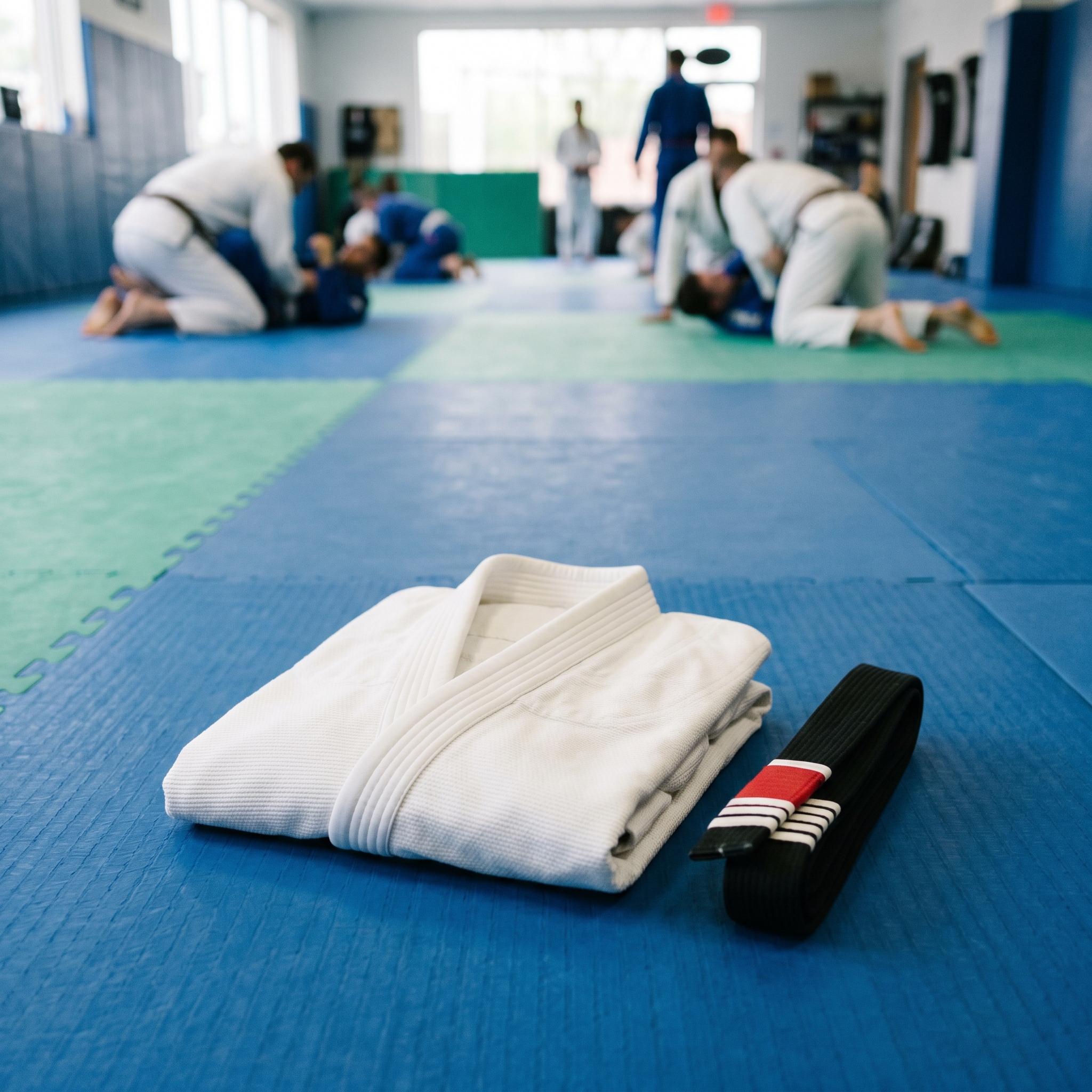
Best BJJ Gi for Beginners: 5 Picks Ranked for 2026
Most "best beginner gi" lists rank by sticker price. After a year of washing, that ranking falls apart. We ranked these five by what actually survives your first year on the mat. The short version: the Sanabul Essentials V3 is the right first gi for most people at $70, the Fuji All Around is the one to grow into, the Elite Sports Core is the cheapest way to test whether jiu-jitsu sticks, the Tatami Estilo 6.0 is for anyone standard sizes never fit, and the Gold BJJ Aeroweave is the premium pick that ends up the cheapest to own.
The 60-second answer
- Best first gi for most people: Sanabul Essentials V3, about $70, comes with a free belt.
- Best to grow into: Fuji All Around, around $105, the gi people still wear at blue belt.
- Cheapest way to test the sport: Elite Sports Core, often near $50, and the only gi here rated for the dryer.
- Best if standard sizes never fit: Tatami Estilo 6.0, around $130, with short, long, and extra-long cuts.
- Cheapest to own over time: Gold BJJ Aeroweave, around $130, that lasts three-plus years.
How we scored these: the JJA First-Gi Score
Every gi here is rated out of 100 on four things that decide whether a beginner is happy with the purchase a year later. The weights are deliberate.
- Durability (30). A first gi takes the worst washing habits of anyone's BJJ career. This matters most.
- Sizing and fit consistency (25). The single biggest source of beginner regret is a gi that arrived wrong or shrank wrong. Brands that size predictably score higher.
- Cost over time (25). Not the price. The price divided by how many years it realistically survives three-times-a-week training.
- Comfort and heat (20). A stiff, sweat-logged gi makes a hard first month harder. It matters, just less than the three above.
What actually matters in a first gi, and what brands oversell
If you already know weave from GSM, skip to the picks. If you do not, this is the whole buying education in five lines.
- Weave and GSM. Pearl weave is the default for a reason: it balances weight and durability. GSM is fabric density. For a beginner, 350 to 550 GSM is the range. Lower is cooler and dries faster; higher lasts longer but feels stiff and hot at first.
- Pant fabric. Cotton twill is comfortable and cheap but blows out at the knee first. Ripstop is lighter and tougher. Either is fine for a beginner; the knee is where pants die regardless.
- The collar. A firm, rubber-cored or tightly stitched collar resists the sweat-soaked sag that makes an old gi feel dead. Soft collars are the first thing a cheap gi loses.
- Pre-shrunk is not shrink-proof. "Pre-shrunk" means most of the shrink is done, not none. Hot water and a dryer will still move the size. Plan around it (see the sizing section).
- IBJJF legality is a non-issue here. All five are legal in standard colors. You only ever need to think about it if you enter an IBJJF event. As a beginner you almost certainly will not for months.
1. Sanabul Essentials V3: the right first gi for most people
If a training partner asks what to buy on day one, this is the answer with no hesitation. The Sanabul Essentials V3 runs $69.99 on Sanabul's site, comes with a free white belt (a real $15 to $20 saving), and ships on Amazon Prime, so you can train in it tomorrow. It is 100% cotton at 380 GSM and IBJJF legal in white, royal blue, and black.
Who it is for: anyone starting out who wants the lowest-risk, lowest-friction option. Who should skip it: heavy daily trainers planning to compete within the year, because the trade for that soft, comfortable-out-of-the-bag fabric is durability.
The failure mode, named honestly: the Sanabul is the softest of these five out of the package and also the first to feel worn. Expect the collar and cuffs to start going around the one-to-two-year mark of three-times-a-week training. For most beginners that is a full belt's worth of use, which is exactly why it still wins for the average new student.
JJA First-Gi Score: 84/100. Best budget pick. Check the Sanabul Essentials V3 on Sanabul's site.
2. Fuji All Around: the gi you grow into
The Fuji All Around is probably the most recommended single gi in BJJ, and the reason is boring in the best way: it does not break. It is a mid-weight traditional weave jacket with cotton twill pants, a stiff thick collar built for real grip, and the kind of reinforcement that shrugs off washing machines. Price lands around $95 to $110 depending on color and where you buy; check the current number on Fuji's page.
This is the only gi on the list a beginner can realistically still be wearing at blue belt. The firm collar that feels stiff in week one is the same collar that still grips for technique in year three. Who should skip it: anyone who runs hot or wants a soft, broken-in feel immediately, because the All Around earns its comfort over months, not on day one.
Failure mode: the cotton twill pants thin at the knee before the jacket shows any age. That is a $25 pants replacement two years in, not a new gi. The jacket outlasts the beginner.
JJA First-Gi Score: 90/100. Best overall for someone who knows they will stick with it. See the Fuji All Around on fujisports.com.
3. Elite Sports Core: the cheapest honest way to find out if BJJ sticks
Half of white belts quit inside a year. That is not cynicism, it is the math of every academy. The Elite Sports Core exists for the version of you that is not sure yet. It is frequently around $49.99 on sale (regular price closer to $59), 450 GSM pearl weave, pre-shrunk, IBJJF legal, and it includes a belt.
The genuinely useful feature is the fabric engineering: Elite builds the Core to survive a machine wash and machine dry, the only gi here you can treat like normal laundry. For a beginner with no gi-care habits yet, that single fact prevents the classic mistake of cooking a gi two sizes smaller in week one. Elite still recommends cold wash and hang dry to maximize lifespan, but the Core forgives the nights you forget.
Who should skip it: anyone already certain they are committed. You will outgrow the Core's durability and want a Fuji or better within a year. Failure mode: it is the most basic build here; expect a shorter life than the Fuji or the Gold, which the price already reflects.
JJA First-Gi Score: 80/100. Best low-commitment starter. Browse the Elite Sports BJJ gi line.
4. Tatami Estilo 6.0: the pick for anyone standard sizes never fit
The most underrated reason beginners hate their first gi has nothing to do with quality. It is fit. A gi cut for an average build hangs badly on a tall, short, or broad one, and the returns and exchanges that follow are the worst part of buying online. Tatami's Estilo 6.0 solves that with the widest size range here: A0 through A6 plus short, long, and extra-long cuts and in-between sizes like A2L and A3H.
It is also a genuinely good gi independent of the sizing story: a 550 GSM pearl weave jacket, 12oz canvas pants, and Y-shaped jacket vents for fit. Expect it around $130; confirm the live price on Tatami's site. Who it is for: anyone who is tall, short, long-armed, or broad and has already been burned by a gi that fit nowhere. Who should skip it: an average build on a tight budget, where the Sanabul does the same job for sixty dollars less.
Failure mode: at 550 GSM this is the hottest gi on the list. The durability is there; the trade is a heavier, warmer roll, especially in a hot gym.
JJA First-Gi Score: 87/100. Best for hard-to-fit bodies. See the Tatami Estilo 6.0 on Tatami's site.
5. Gold BJJ Aeroweave: the premium pick that is the cheapest to own
This is the contrarian one, and the cost-over-time math is why. The Gold BJJ Aeroweave Ultralight is about $130, the same neighborhood as the Tatami, and it is the priciest gi most beginners would consider. It is also, on a per-year basis, the cheapest gi on this entire list.
The Aeroweave uses a roughly 275 GSM fabric that wears about 40% lighter than a standard pearl weave, with reinforced stitching at every stress point. Across independent BJJ reviewers, the recurring report is the same: three-plus years of regular training with no tears. It is pre-shrunk, and worth noting it runs slightly large even so, so size down if you are between sizes. Who should skip it: someone genuinely unsure they will keep training, where spending $130 to find out is the wrong bet (buy the Elite Core instead).
Failure mode: the honest one here is fit, not durability. Several reviewers find it baggier than expected out of the bag. On a light gi that softens with washes, most people adjust; if you want a tailored look immediately, this is not it.
JJA First-Gi Score: 91/100. Best long-term value. Check the Gold BJJ Aeroweave on goldbjj.com.
The cheapest gi to buy is not the cheapest to own
Here is the table no other beginner guide runs. Lifespan is an estimate from construction and reported failure patterns, assuming three sessions a week. Treat the cost-per-year column as a planning tool, not a spec sheet.
| Gi | Price | Estimated lifespan (3x/week) | Estimated cost per year | |----|-------|------------------------------|-------------------------| | Elite Sports Core | ~$50 | ~1.5 years | ~$33 | | Sanabul Essentials V3 | ~$70 | ~2 years | ~$35 | | Fuji All Around | ~$105 | ~4 years | ~$26 | | Tatami Estilo 6.0 | ~$130 | ~4 years | ~$33 | | Gold BJJ Aeroweave | ~$130 | ~4.5 years | ~$29 |
The cheapest gi to buy (Elite Core at ~$50) is the most expensive of the durable options to own once you account for how fast a basic build wears. The Fuji All Around, the priciest "value" pick at first glance, is the cheapest gi here to keep on the mat. That is the entire argument for not buying the cheapest thing if you already know you are staying.
The honest exception: if you are genuinely unsure you will still be training in six months, cost-per-year does not apply to you yet. Buy the cheap one, find out, then buy the Fuji.
What size BJJ gi should you buy, and how much it shrinks
There is no universal gi sizing standard. Every brand cuts differently and every fabric shrinks differently, which is why "what size am I" is the most-asked beginner question and the most-dodged in other guides. Here is a usable starting point. Always check the specific brand's chart, then adjust.
| Your height | Your weight | Start at | |-------------|-------------|----------| | Under 5'4" | Under 140 lbs | A0 | | 5'4" to 5'7" | 130 to 160 lbs | A1 | | 5'7" to 5'10" | 150 to 185 lbs | A2 | | 5'10" to 6'1" | 175 to 210 lbs | A3 | | 6'1" to 6'4" | 200 to 240 lbs | A4 |
Shrinkage rule: a pre-shrunk cotton gi washed cold and hung dry moves very little. The same gi through hot water and a dryer can drop close to a full size, mostly in the jacket length and sleeves. If you are between sizes and you will hang dry, size up. If you are between sizes and you know you will use a dryer, size down and accept it. The Gold BJJ runs slightly large; the Elite Core is built to take the dryer without much movement. Everything else: cold wash, hang dry, and the chart holds.
Quick comparison
| Gi | Price | Jacket | Pants | Sizes | IBJJF legal | Best for | |----|-------|--------|-------|-------|-------------|----------| | Sanabul Essentials V3 | ~$70 | 380 GSM cotton | Cotton | A0-A5 | Yes | Most beginners | | Fuji All Around | ~$105 | Mid-weight traditional weave | Cotton twill | Wide | Yes | Growing into the sport | | Elite Sports Core | ~$50 | 450 GSM pearl weave | Cotton | A0-A5 | Yes | Testing if BJJ sticks | | Tatami Estilo 6.0 | ~$130 | 550 GSM pearl weave | 12oz canvas | A0-A6 plus S/L/XL | Yes | Hard-to-fit bodies | | Gold BJJ Aeroweave | ~$130 | ~275 GSM Aeroweave | Ripstop | A0-A5 | Yes | Long-term value |
So which one should you buy?
If you just signed up and want one safe answer, buy the Sanabul Essentials V3 and stop reading. If you already know you are committed, the Fuji All Around costs less per year than the budget gi and outlasts your white belt. If you are not sure jiu-jitsu is for you, the Elite Sports Core is the cheap, dryer-safe way to find out. If standard sizes have never fit your body, the Tatami Estilo 6.0 is worth the premium for the cut alone. And if you want the best long-term value and do not mind paying it up front, the Gold BJJ Aeroweave is the cheapest gi here to own.
Whichever you pick, if you train more than three times a week, buy two. One is always drying while the other is on the mat.
Related reading
- Best Kids BJJ Gi: 5 Top Picks for Young Grapplers if you are also kitting out a young grappler.
- Looking for somewhere to train? Browse academies by state on the Jiu Jitsu Authority gym directory.
How we researched this
A note on transparency: this is a virtual review. We did not stress-test all five gis ourselves over months of training. Here is how the recommendations were built:
- Manufacturer confirmation. Price, weave, GSM, pant fabric, sizing, and IBJJF status were pulled from each brand's official product page. Where a brand did not publish a clean current price, we say "around" and link the page so you can verify the live number.
- Practitioner and community signal. We cross-referenced established BJJ gear reviewers and the recurring r/bjj consensus on durability, sizing, and what fails first on each model.
- Construction knowledge. GSM bands, weave trade-offs, collar and pant failure points, and shrinkage behavior are applied from years inside the sport to judge which specs matter for a beginner and which are marketing.
- The cost-per-year figures are estimates, built from construction and reported failure patterns, not lab testing, and labeled that way wherever they appear.
---
Written by Gabriel Urreola, May 17, 2026, 12 min read
Disclosure: This article may contain affiliate links. Prices and availability change. Check product pages for current details.