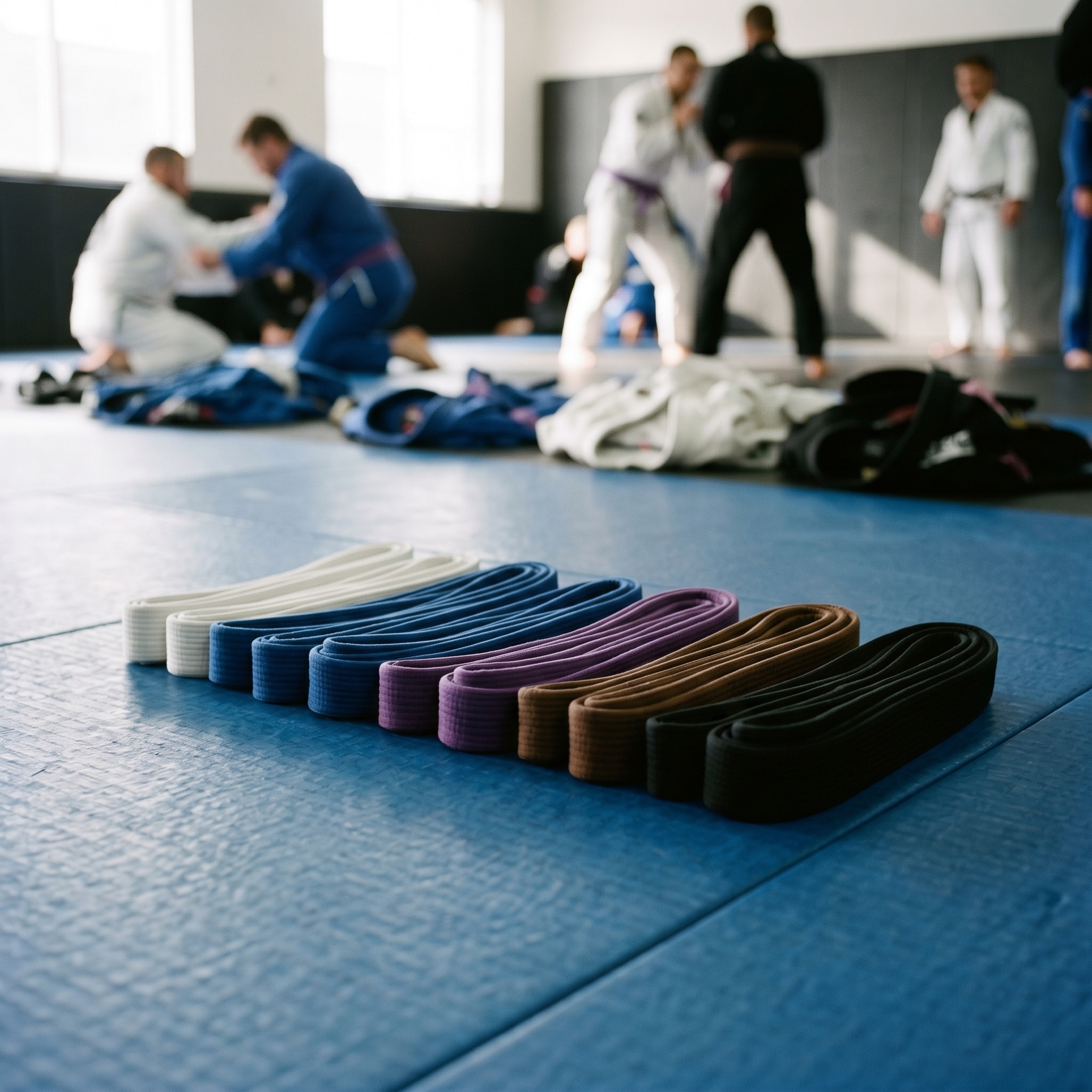
BJJ Belt System Explained: Complete Guide from White Belt to Black Belt
Last Updated: January 2026
Quick Answer: The BJJ belt system consists of five adult belts: white, blue, purple, brown, and black. Unlike other martial arts, promotions in BJJ are based on demonstrated skill and time on the mat—not tests or fees. Most practitioners spend 10-15 years reaching black belt, making it one of the most meaningful rank progressions in martial arts.
---
Key Takeaways
- BJJ has 5 adult belts (white, blue, purple, brown, black) and 5 kids' belts with different colors
- Promotions are based on skill, mat time, and your instructor's judgment—not standardized tests
- Average time to black belt is 10-15 years of consistent training
- Each belt has 4 stripes (degrees) that mark progress within that rank
- The belt system is deliberately slow—it ensures BJJ black belts have genuine, tested skill
The Adult BJJ Belt System
White Belt
The beginning. Everyone starts as a white belt, regardless of athletic background or experience in other martial arts. The white belt is about surviving, learning fundamentals, and building the base you'll use for your entire BJJ journey.
What you'll learn:
- Basic positions (guard, mount, side control, back control)
- Fundamental escapes (mount escape, side control escape)
- Entry-level submissions (armbar, rear-naked choke, triangle)
- Proper posture and base
- Mat etiquette and safety
Average time at white belt: 1-2 years
How to succeed:
- Focus on defense and survival before attacking
- Tap early, tap often (ego causes injuries)
- Attend class consistently (3x/week minimum)
- Ask questions—upper belts were in your position once
- Don't compare your progress to others
---
Blue Belt
The foundation is set. Blue belt represents your first major milestone—you've internalized the basics and can execute techniques against resisting opponents. Many practitioners consider blue belt the "most fun" rank because you finally know enough to actually play the game.
What changes at blue belt:
- You can defend yourself against most untrained people
- Techniques start flowing without conscious thought
- You begin developing a personal "game" (preferred positions/submissions)
- Rolling becomes more strategic, less survival-focused
- Upper belts start challenging you more
- Guard systems (open guard, half guard, butterfly)
- Guard passing strategies
- Chaining attacks together
- Timing and setups (not just techniques)
- Deeper understanding of leverage and weight distribution
Average time at blue belt: 2-3 years
How to succeed:
- Develop your A-game (positions that work for you)
- Start identifying your weaknesses deliberately
- Begin teaching newer students (teaching accelerates learning)
- Consider competition to test your skills
- Resist the "blue belt quit"—this is where many tap out
Purple Belt
The transition to advanced. Purple belt marks the beginning of the "upper belt" ranks. You're no longer just executing techniques—you're understanding concepts, adapting on the fly, and developing a sophisticated game.
What changes at purple belt:
- Teaching responsibilities often increase
- You can give white and blue belts significant challenges
- Technical creativity emerges—you start inventing solutions
- Understanding of timing and pressure deepens
- Competition success becomes more achievable
- Advanced guard systems and passes
- Leg locks (increasingly important in modern BJJ)
- Strategic game planning
- Adapting techniques to your body type and attributes
- Deeper conceptual understanding (not just "what" but "why")
Average time at purple belt: 2-3 years
How to succeed:
- Embrace the teaching role—it forces deeper understanding
- Address your weaknesses systematically (not just playing your strengths)
- Study competition footage and high-level practitioners
- Train with a variety of body types and styles
- Maintain perspective during plateaus
Brown Belt
Refinement and mastery. Brown belt is the final preparation for black belt. The focus shifts from learning new techniques to refining what you know. Brown belts smooth out rough edges, eliminate bad habits, and develop the consistent execution that defines black belt skill.
What changes at brown belt:
- Your game becomes highly polished
- Newer students look to you as an authority
- The gap between you and lower belts is substantial
- Teaching becomes a significant responsibility
- You can hang with most black belts in training
- Advanced concepts and micro-adjustments
- Troubleshooting your entire game
- Leadership and teaching skills
- Mental aspects of high-level competition
- The patience required for true mastery
Average time at brown belt: 1-2 years
How to succeed:
- Polish your existing techniques rather than chasing new ones
- Invest heavily in teaching lower belts
- Compete to test yourself (if you haven't already)
- Develop mental resilience and consistency
- Trust the process—your instructor sees what you might not
Black Belt
Mastery—and the beginning of true learning. A BJJ black belt represents approximately 10-15 years of dedicated training, thousands of hours on the mat, and demonstrated technical excellence. Unlike many martial arts, BJJ black belts can genuinely defeat lower-ranked practitioners.
What a black belt represents:
- Technical mastery of fundamentals and advanced positions
- The ability to teach effectively at all levels
- Competitive ability against other trained practitioners
- Contribution to the BJJ community
- A deep understanding of concepts, not just techniques
- 1st-6th Degree: Earned through continued training, teaching, and contribution
- 7th Degree (Coral Belt): Red and black belt, typically 30+ years of practice
- 8th Degree (Coral Belt): Red and white belt
- 9th Degree (Red Belt): Reserved for pioneers of the art
- 10th Degree (Red Belt): Only awarded to the Gracie family founders
What black belts will tell you:
- "Black belt is when you truly start learning"
- "The only difference is I've made mistakes longer"
- "I still have bad days—belts don't change that"
The Kids' Belt System
Children under 16 follow a different progression designed to keep them motivated while acknowledging they're still developing physically:
| Belt | Order | |------|-------| | White | 1st | | Gray | 2nd | | Yellow | 3rd | | Orange | 4th | | Green | 5th |
Key differences for kids:
- More belts create more opportunities for recognition
- Stripes (degrees) work the same way as adult belts
- At age 16, kids transition to adult belts
- Transition is typically: green belt → blue belt (with adjustments based on skill)
---
The Stripe System
Within each belt, practitioners earn stripes (also called degrees) that mark progress toward the next rank:
- 4 stripes maximum per belt (except black belt, which has degrees)
- Stripes represent: Progress, dedication, and skill within your current rank
- Who awards them: Your instructor, based on their assessment
- When: Variable—could be weeks or months between stripes
Don't obsess over stripes. They're markers of progress, not the goal. Focus on improvement; recognition follows.
---
How Promotions Work in BJJ
Unlike many martial arts, BJJ has no standardized testing, fixed timelines, or promotion fees.
What Instructors Look For
Technical skill:
- Execution of techniques under pressure
- Ability to apply techniques against resisting opponents
- Understanding of concepts, not just moves
- Demonstrated progression over time
- Consistent training over extended periods
- Quality of training (intensity, focus)
- Exposure to different training partners and styles
- Respect for training partners and the art
- Humility and willingness to learn
- Teaching and helping others
- Representation of the gym/team
- Not required for promotion at most gyms
- Can demonstrate skill under pressure
- Shows commitment to testing yourself
Minimum Time Requirements
The IBJJF (International Brazilian Jiu-Jitsu Federation) sets minimum times between belts for official competition ranking:
| Belt | Minimum Age | Minimum Time | |------|-------------|--------------| | White | 16 | N/A | | Blue | 16 | 2 years at white | | Purple | 16 | 1.5 years at blue | | Brown | 18 | 1.5 years at purple | | Black | 19 | 1 year at brown |
Note: These are minimums. Most practitioners spend significantly longer at each belt.
Why BJJ Promotions Are Slow
BJJ's slow promotion timeline is intentional and meaningful:
1. Skill verification: You can't fake it—promotions require demonstrated ability 2. Respect for the art: Each belt genuinely represents years of work 3. Quality control: BJJ black belts have proven, testable skills 4. Depth over breadth: More time means deeper understanding, not just more techniques
---
Common Questions About the Belt System
How long does it take to get each belt?
| Belt Transition | Typical Time | Fast Track | Slower Path | |-----------------|--------------|------------|-------------| | White → Blue | 1-2 years | 8-12 months | 3+ years | | Blue → Purple | 2-3 years | 1.5-2 years | 4+ years | | Purple → Brown | 2-3 years | 1.5-2 years | 4+ years | | Brown → Black | 1-2 years | 1 year | 3+ years | | Total to Black | 10-15 years | 7-8 years | 15+ years |
Factors that affect timeline:
- Training frequency (2x/week vs. 5x/week)
- Athletic background (wrestling, judo accelerate early progress)
- Competition experience
- Instructor's promotion philosophy
- Natural ability and body type
Why do some people get promoted faster?
Several legitimate reasons:
- Higher training frequency: Someone training 10x/week progresses faster than 2x/week
- Previous grappling experience: Wrestlers, judokas, and sambo practitioners have transferable skills
- Competition success: Proves skill under pressure
- Professional training: Full-time athletes progress faster than hobbyists
Is it okay to ask about promotions?
Generally, no. BJJ culture discourages asking about promotions directly. Here's why:
- Your instructor is watching your progress constantly
- Asking can seem presumptuous or impatient
- Belts come when you're ready, not when you want them
- Focus on improvement; recognition follows
What if I think I should have been promoted?
This is common, especially at white and blue belt. Consider:
- Your instructor sees what you don't. They've watched many students progress.
- Promotions aren't just technical. Consistency, attitude, and mat time matter.
- The belt doesn't change your skills. You're the same grappler either way.
- Trust the process. If you're consistently training and improving, promotion will come.
Do belts matter?
Yes and no.
Belts matter because:
- They represent genuine skill levels
- They help structure training (matching partners appropriately)
- They're meaningful milestones after significant work
- They carry respect within the community
- A 4-stripe blue belt can beat a fresh purple belt
- Your skill is your skill, regardless of what's around your waist
- Obsessing over belts undermines the journey
- The goal is improvement, not collection
Belt Colors and Their Meaning
| Belt | Color | Symbolism | |------|-------|-----------| | White | White | Purity, beginning, empty cup ready to learn | | Blue | Blue | Sky—the student can now see the horizon | | Purple | Purple | Twilight—between the light of fundamentals and the darkness of advanced | | Brown | Brown | Earth—grounded, stable, nearly complete | | Black | Black | Mastery, and the darkness beyond what you thought you knew |
These traditional meanings aren't universal—many practitioners simply see the colors as markers without deeper symbolism.
---
Frequently Asked Questions
Can you skip belts in BJJ?
Extremely rare. High-level wrestlers or judokas might receive blue belt quickly, but skipping colors (white straight to purple, for example) almost never happens. BJJ's culture values time on the mat.
What belt is required to teach BJJ?
Traditionally, purple belt is the minimum to lead classes, though this varies by gym. Blue belts often assist with instruction under supervision. Black belt is typically required to run your own academy and promote others.
Do BJJ belts transfer between gyms?
Generally yes—your belt follows you when you change gyms. However, some instructors may want to evaluate your skills before accepting your rank, especially for upper belts. This isn't disrespectful; it's quality control.
What's the difference between BJJ and judo/karate belt systems?
BJJ: 5 adult belts, no standardized tests, 10-15 years to black belt, promotions based on demonstrated skill.
Judo: More belts, faster progression, structured curriculum, includes black belt tests.
Karate: Highly variable by style, often test-based, can reach black belt in 3-5 years (varies dramatically).
Key difference: BJJ's slow progression and emphasis on live sparring means belts more reliably indicate actual fighting ability.
Can you lose your belt?
Technically possible but rare. Circumstances might include:
- Extended absence from training (years)
- Instructor error in promotion
- Behavior that disgraces the art
---
Summary: Your Belt Journey
The BJJ belt system is one of the most meaningful ranking systems in martial arts because it's earned through demonstrated skill, not tests or fees. Each belt represents years of dedicated practice, countless hours of being submitted, and gradual mastery of a complex art.
Whether you're a brand-new white belt wondering what you've gotten into, or a blue belt pushing through the infamous "blue belt blues," remember: the belt is just a marker. The real value is in who you become through the process—more patient, more humble, more capable, and part of a global community of grapplers.
Key points to remember:
- Progress takes time—enjoy the journey, not just the destinations
- Consistent mat time matters more than natural talent
- Each belt is earned through demonstrated skill, not given
- The black belt is a beginning, not an end
- Your belt doesn't define you—your character on the mat does
Related Reading:
- What to Expect at Your First BJJ Class
- How to Choose the Right BJJ Gym
- Is BJJ Good for Self Defense?
Questions about the belt system or your own progression? Drop a comment below—we've all been there and we're happy to help!